ABOUT RED TIDE RISING
This is where our journey begins. Get to know our business and what we do, and how we're committed to quality and great service. Join us as we grow and succeed together. We're glad you're here to be a part of our story.
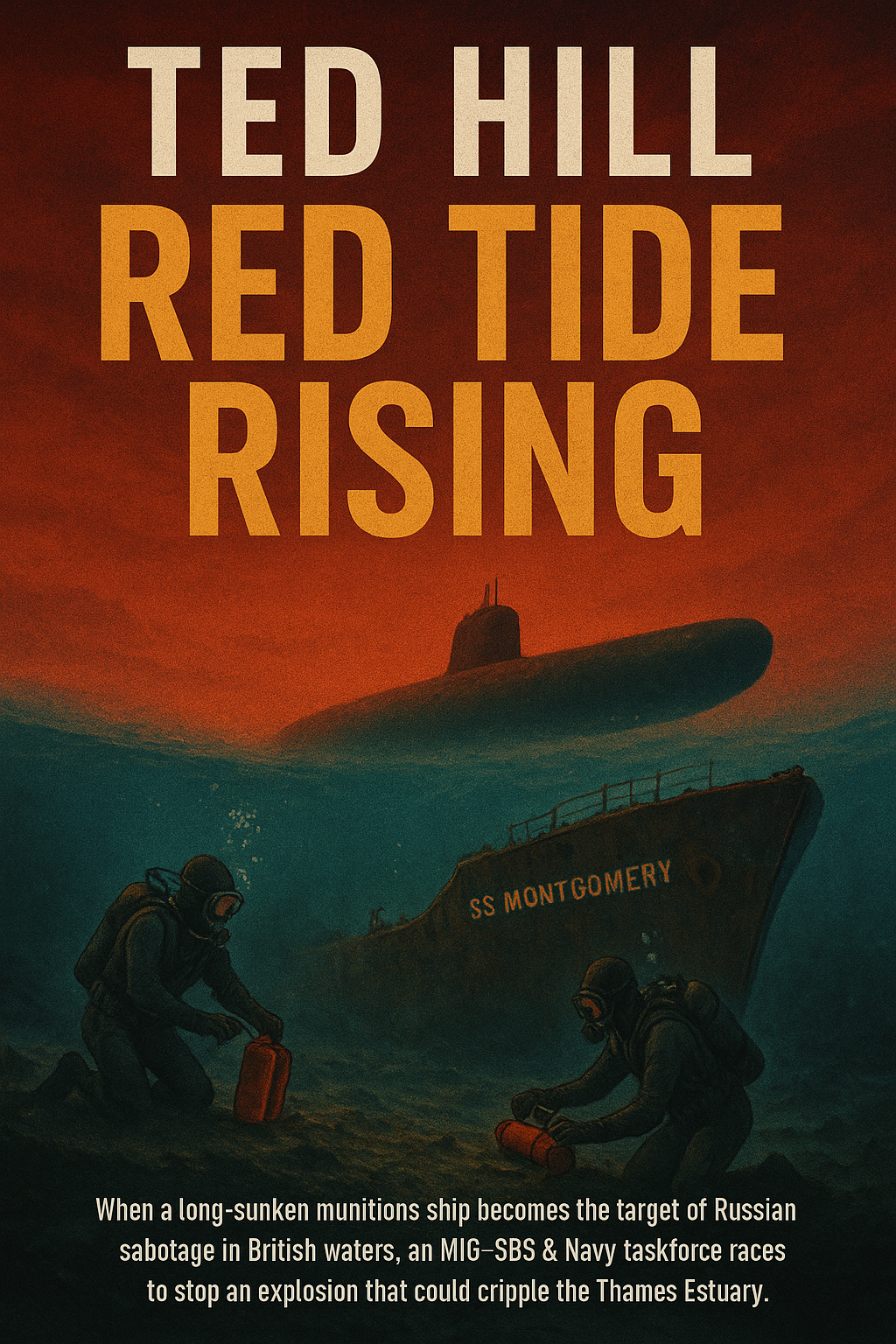
Red Tide Rising
When a long-sunken munitions ship becomes the target of Russian sabotage in British waters, a MI6, SBS & Navy task force races to stop an explosion that could cripple the Thames Estuary, fearing the detonation of a Tsunami bomb.
https://novelo.com/browse/paid
Project Seal
Project Seal was a joint military research programme conducted by the United States and New Zealand in 1944. It originated from observations by U.S. Navy Commander E.A. Gibson, who noted that explosive charges used to clear coral reefs sometimes produced large waves. This prompted an investigation into whether controlled explosions could generate destructive tidal waves capable of damaging enemy coastal defences.
Led by Professor Thomas Leech of Auckland University College, the project carried out extensive testing near the Whangaparāoa Peninsula, New Zealand. Over a seven-month period, approximately 3,700 controlled detonations were conducted using various charge sizes to study the effects on wave generation.
Results showed that underwater explosions were less effective than expected; detonations nearer the surface produced larger waves, but single explosions rarely created waves of military significance. The research concluded that a sequence of multiple, precisely timed blasts would be required to achieve a major effect.
The project was discontinued in January 1945, judged technically impractical and strategically unnecessary as the war’s outcome became clearer. Although no usable weapon emerged, Project Seal contributed valuable data on wave physics and demonstrated the extent of wartime experimentation with unconventional weapon concepts. The programme remained classified until the late 1990s.
Poseidon Weapon System
The Poseidon underwater weapon system, initially known by the Russian codename Status-6—is an autonomous, nuclear-powered unmanned underwater vehicle reportedly developed to deliver both conventional and nuclear payloads. Russian President Vladimir Putin first publicly referred to it among a group of new strategic weapons in March 2018.
Information about the system first appeared in November 2015, when Russian state television broadcast a document describing an “oceanic multi-purpose system” named Status-6. Although described as an accidental disclosure, most analysts believe the leak was deliberate.
Reports in early 2023 suggested that the first production units had been manufactured, though this was never officially confirmed. In October 2025, President Putin announced that a Poseidon test had been successfully completed.
Design assessments indicate that Poseidon employs low-speed transit for reduced acoustic detectability, switching to high-speed operation only in its final approach to the target. Russian media have claimed the system could generate large waves or even tsunamis if detonated underwater; however, experts argue that such effects would be limited, as waves from explosions dissipate rapidly compared to those generated by geological events.
Poseidon is widely regarded as a psychological or strategic deterrent rather than a practical weapon. Any nuclear use against a NATO member would trigger Article 5 of the NATO Treaty, risking full nuclear escalation.
SS Richard Montgomery
The SS Richard Montgomery was an American Liberty ship that sank in the Thames Estuary in August 1944 while carrying approximately 1,400 tons of explosives. The vessel ran aground on a sandbank near Sheerness and broke apart, leaving much of its cargo of munitions intact.
The wreck remains on the seabed and continues to present a potential hazard due to the unstable condition of the explosives. In the event of a worst-case detonation, the estimated blast radius could extend 16–40 kilometres, generating a wave of up to five metres and causing serious structural damage to surrounding areas, including Sheerness, approximately 2.5 kilometres away.
Although the risk of an explosion is considered low, the site is continuously monitored and protected under the Protection of Wrecks Act 1973. A 500-metre exclusion zone is enforced to prevent disturbance and ensure maritime safety.
The Richard Montgomery remains one of Britain’s most closely observed shipwrecks—a persistent reminder of the long-term hazards left by wartime logistics.